Why Does My Dog Follow Me Everywhere? The Sweet Reasons
From kitchen footsteps to bathroom door duty, here is what drives your dog's constant shadowing and what it says about your bond.
🐾 Free: what would your dog say about you?
Answer 6 questions →Your dog follows you everywhere because you represent safety, social connection, and the central focus of their daily environment. Dogs are naturally cooperative, pack-oriented animals that track the movements of their trusted human companions across the household. This continuous shadowing stems from a mix of biological attachment, routine anticipation, curiosity, and learned reward patterns.
Short answer: Your dog follows you everywhere primarily because you are their main source of food, affection, security, and interesting activities. Dogs form strong social attachments and naturally want to monitor their home environment. Following you from room to room allows them to supervise daily routines, stay close to their favorite human, and catch unexpected rewards.
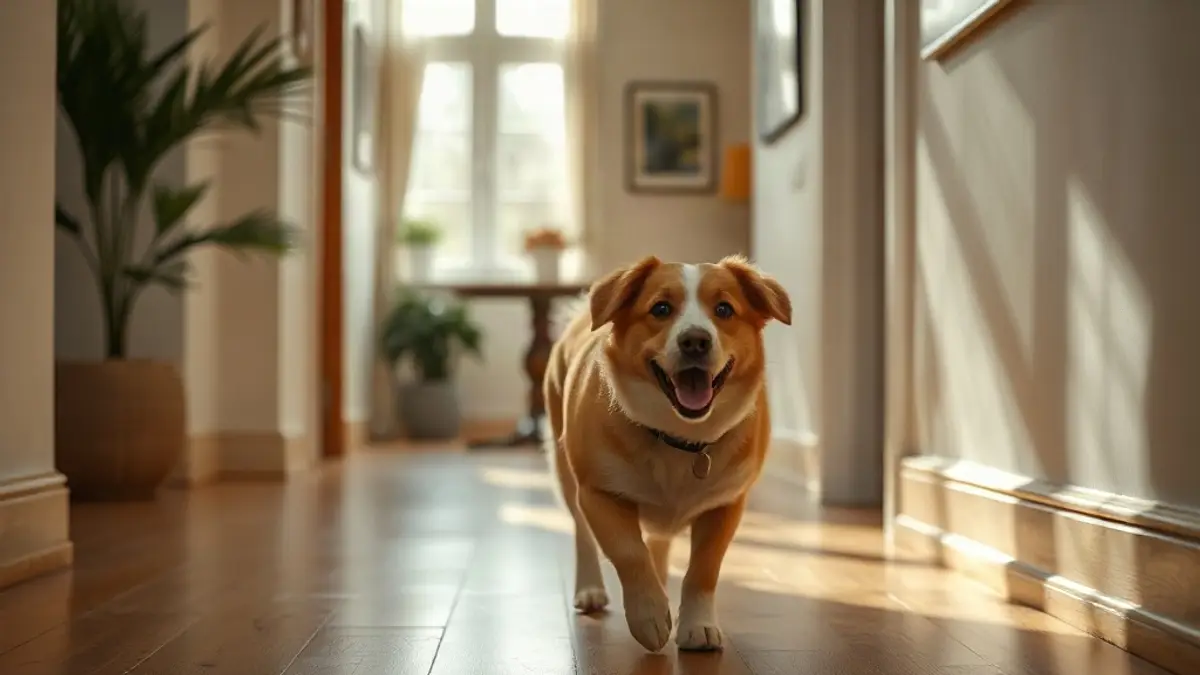
Why does my dog follow me everywhere? The psychology of canine companionship
To understand why your dog follows you everywhere, it helps to look at how domestic dogs perceive their social world. Dogs have evolved alongside humans for thousands of years, developing a unique ability to read human body language, tone of voice, and daily movements. When you stand up from your desk, pick up a coffee mug, or walk toward the hallway, your dog receives a series of visual and auditory cues that signal an impending event.
In a typical household, the human initiates almost every event of interest. You are the opener of back doors, the provider of crunchy treats, the retriever of lost tennis balls, and the dispenser of belly rubs. Because so many good things originate from your actions, your dog learns that staying close to you pays off. Observing what your dog thinks of you reveals that your movements serve as the primary entertainment and security system for your pet.
Consider a hypothetical beagle named Pepper. Whenever Pepper’s owner stands up, Pepper immediately sits up from her dog bed, taps her nails across the hardwood floor, and matches her owner’s cadence into the hallway. Pepper is not necessarily expecting a full meal every time her owner shifts positions; rather, she is participating in the natural social flow of the household. Staying near her human ensures she never misses an open back door, an stray piece of dropped cheese, or a quick ear scratch.
This behavior is rooted in basic canine biology. Dogs are hardwired to seek social proximity. Being near you lowers their stress levels and provides them with a comforting sense of predictability in a human-dominated environment.
Common reasons why your dog follows you room to room
While social bonding is the general underlying cause, specific triggers influence why your dog follows you room to room throughout the day. Recognizing these patterns helps you understand what your dog is seeking in any given moment.
Reinforcement and reward loops
Every time you turn around and smile at your dog, speak in a gentle voice, or toss a stray piece of crust while cooking, you reinforce their decision to tag along. Dogs excel at associative learning. If walking into the laundry room with you occasionally results in finding an forgotten chew toy or getting a quick chin scratch, your dog registers that room as a high-value destination. Even negative attention, such as sighing or telling your dog to move out of the doorway, can act as a reward for a dog who simply wants interaction.
Routine anticipation and pattern recognition
Dogs possess an impressive internal clock paired with acute pattern recognition. They notice micro-routines you might not even realize you have. For instance, shutting down a laptop, folding a pair of reading glasses, or reaching for a specific jacket signals that outdoor recreation or dinnertime is approaching. By tracking you from room to room, your dog ensures they are in prime position when the predicted activity begins. If you want to dive deeper into these subtle signals, exploring why your dog stares at you can help clarify how closely they monitor your subtle shifts in posture.
Natural curiosity and environmental awareness
Dogs experience the world primarily through smell and sound, but they rely on spatial awareness to maintain security. When you leave a room, the social landscape changes. Following you allows your dog to investigate what you are doing in the next space. Whether you are folding warm laundry fresh from the dryer or moving a box in the hallway, your dog views your activity as a living event worth checking out.
Breed instincts and working genetics
Genetics play a substantial role in how closely a dog clings to their owner. Working breeds, herding dogs, and companion breeds have been selectively bred for generations to pay intense attention to human handlers:
- Herding breeds (Border Collies, Australian Shepherds, German Shepherds): Bred to drive livestock and respond to subtle handler cues, these dogs naturally shadow your heels and keep visual tabs on your position.
- Sporting breeds (Golden Retrievers, Labrador Retrievers, Spaniels): Bred to work closely alongside hunters in the field, they naturally seek continuous partnership and physical proximity.
- Companion breeds (Pugs, French Bulldogs, Cavalier King Charles Spaniels): Bred specifically to offer affection and lap-sitting company, their primary job in life is to remain attached to your side.
Why does my dog always want to be near me? Understanding attachment styles
When you ask yourself, “Why does my dog always want to be near me?” you are observing the canine equivalent of a secure bond. In developmental psychology, a primary caregiver acts as a secure base. When a child or dependent animal feels safe near their caregiver, they feel comfortable exploring their surrounding environment because they know their safe port is nearby.
Dogs view their favorite humans as this exact security anchor. Research into separation anxiety in dogs demonstrates that physical proximity to a primary owner buffers a dog against environmental stressors, such as loud noises, unfamiliar visitors, or sudden weather changes. Being near you allows your dog’s nervous system to remain relaxed.
Understanding whether you are your dog’s safe place helps contextualize this behavior. When your dog rests their chin on your foot while you wash dishes or curls up against your leg while you read, they are utilizing your physical presence to settle their energy.
| Context or Scenario | Likely Underlying Reason | What It Means for You |
|---|---|---|
| Following closely into the kitchen | Reinforcement & food anticipation | They have learned that kitchen activity often yields edible rewards or dropped scraps. |
| Waiting right outside the bathroom door | Pack monitoring & boundary instinct | A closed door breaks social contact; waiting ensures immediate reunion upon opening. |
| Shifting positions whenever you move on the couch | High attachment & secure base habit | They want to maintain physical contact or alignment with your body for comfort. |
| Tagging along when you pick up keys or shoes | Routine recognition & walk anticipation | They associate specific objects with an upcoming trip outdoors or a car ride. |
| Resting on your feet while you work at a desk | Social companionship & affection | They are content simply sharing your physical space without expecting active play. |
The phenomenon of the velcro dog
In the dog-loving world, dogs that follow their humans with zero clearance are affectionately referred to as a velcro dog. While any breed can exhibit velcro tendencies, the trait is particularly pronounced in dogs that form an exclusive attachment to one specific household member.
Being a velcro dog is not inherently a problem. In most cases, it is a sweet manifestation of trust and companionship. Your dog simply prefers your company over lying alone in an empty room. They like the sound of your voice, the familiar smell of your worn sweater, and the gentle rhythm of your daily routine. Determining am I my dog’s favorite person often comes down to tracking who the dog chooses to follow when multiple people are active in the home.
If you ever wonder what is going through your dog’s head as they follow you across the hallway for the fifth time today, you can explore their unique perspective in a fun way. Try the free six-question experience to see what your dog might say about your daily habits and shared routines. It takes about a minute, requires no account or signup, and gives you a lighthearted glimpse into how your dog views your bond.
However, there is a clear boundary between a companion who enjoys shadowing you and a dog who cannot function emotionally without keeping you in sight. Balancing close attachment with independent confidence ensures your dog feels secure even when you step into another room.
Why does my dog follow me to the bathroom?
One of the most universal experiences for dog owners is looking down while sitting in the bathroom only to find a wet nose nudging the door frame. Why does my dog sit next to me or stand guard in the bathroom?
The bathroom phenomenon comes down to three basic factors: closed doors, barrier frustration, and vulnerable routines.
- Closed doors create curiosity: In a dog’s mind, an open door means accessible space, while a closed door is a mystery. When you enter a room and shut the door, you temporarily exclude your dog from the pack, which prompts them to wait on the other side or slip in before the latch catches.
- Vulnerable positions: In wild canine dynamics, pack members look out for one another during moments when an animal might be vulnerable. Sitting down in a quiet room signals a low-energy moment where your dog feels completely safe hanging out beside you.
- Captive audience: Dogs quickly learn that when you are sitting in the bathroom, you are static and available. You are not walking briskly past them or carrying heavy items. It is a prime opportunity for them to receive eye contact, quiet praise, or a slow head scratch.
When following becomes a sign of distress or anxiety
While having a constant shadow is usually harmless and affectionate, excessive following can sometimes indicate underlying emotional distress or health issues. It is important to distinguish between a healthy companion and a dog experiencing hyper-attachment or anxiety.
Red flags to watch for
If your dog exhibits any of the following behaviors alongside shadowing, their following may be driven by stress rather than relaxed companionship:
- Pacing, panting, or whining loudly whenever you move between rooms
- Inability to settle or sleep unless they are touching your body
- Dilated pupils, trembling, or hyperventilating when you prepare to leave
- Destructive behavior, excessive barking, or house soiling when left alone for brief periods
- Sudden, drastic changes in following behavior in a dog that was previously independent
When sudden behavioral changes, severe separation anxiety, or signs of physical discomfort appear, it is important to consult a veterinarian or a credentialed professional dog trainer. A medical evaluation can rule out underlying pain or sensory loss—such as fading eyesight or hearing—which often causes older dogs to cling to their owners for guidance. A qualified trainer can help you build gradual independence using positive, stress-free methods.
What your shadow might write in a letter
If your dog could translate their constant steps into words, their explanation for following you would probably not be about pack hierarchy or behavioral science. It would be about the specific, quiet details of your daily life together.
Imagine receiving a small note found near the bottom of the stairs, written by the four-legged shadow that has been keeping pace with your slippers all morning:
Dear Person,
I noticed you stood up from the comfortable sofa, so naturally I stood up too. You walked six feet into the kitchen to pour water, and I made sure to stand exactly two inches behind your left heel just in case you stepped backward or needed help monitoring the refrigerator drawer.
I know you think I follow you because I am hoping for a piece of yellow cheese. And to be completely honest, if cheese happens to slip from your fingers, I am fully prepared to clear it off the floor tiles before it hits the ground. But mostly, I just like being where you are.
When you go into the small room and shut the white door, I sit on the rug outside because the house feels remarkably quiet when you are on the other side of a panel. When you move to the laundry room, I like the warm smell of the shirts coming out of the machine, but I like watching your hands fold them even more.
You move through the rooms in a very specific pattern, and I have memorized all of it. I know the sound your shoes make right before we go outside, and I know the soft sigh you give right before you sit down for the evening. Wherever you are heading next, that is where I want to be.
Yours from three inches behind,
Your Shadow
Turning this into a keepsake
If you love the quiet, dedicated way your dog stays by your side throughout the day, you can turn those sweet daily habits into a personalized keepsake. At Letter From My Dog, we help dog owners celebrate the tiny, specific quirks that make their bond unique.
Our flagship product, the personalized letter from your dog ($7, one-time payment), is a custom digital print written from your dog’s point of view. Built entirely from the specific details you share about your dog’s habits—like how they shadow you to the bathroom or wait by the kitchen counter—it includes a beautifully written main letter, Our Bond Story, 10 Little Things Your Dog Loves About Life With You, The Tiny Things™, bonding ideas, and a printable PDF designed for framing at home. You also receive a custom phone wallpaper and an Instagram story share card.
If you want to explore other formats, we also offer a personalized digital dog storybook ($19) that turns your dog into the star of a illustrated digital tale, and a custom Dog Movie Poster Pack™ ($4) that transforms your pet into a legendary cinematic hero. Every keepsake is created from your answers with the assistance of generative AI, delivering a high-quality keepsake directly to your inbox after purchase with no physical shipping required.
Frequently asked questions
Why does my dog sit next to me when I work?
Your dog sits next to you while you work because your workstation represents a predictable, low-stress location where you remain static for long periods. Dogs prefer being close to their primary social bond, and sitting near your desk allows them to rest quietly while remaining part of your immediate environment without disturbing your focus.
Is it normal for my dog to follow me everywhere suddenly?
While following is normal behavior, a sudden increase in shadowing can signal changes in your dog’s health, vision, hearing, or stress levels. Older dogs entering senior years may cling closer as their senses decline. If the behavior change is abrupt or accompanied by panting, restlessness, or vocalization, schedule a checkup with your veterinarian to rule out underlying pain or medical issues.
Does my dog follow me everywhere because they think they are the leader?
No. Modern animal behavior science shows that following an owner is not an attempt to dominate or assert control over the household. Instead, dogs shadow humans because we control access to resources like food, play, and outdoor access, and because they feel secure and bonded in our physical presence.
Why does my dog sleep next to my feet when I move rooms?
Sleeping at your feet allows your dog to stay physically connected while resting. By positioning themselves against your feet or near the entryway of the room, your dog can instantly sense when you stand up or change positions, allowing them to wake up and adjust without losing track of your location.
Should I stop my dog from following me everywhere?
If your dog is calm, relaxed, and capable of resting peacefully in another room when you leave, there is no need to stop them from following you. However, if your dog shows signs of panic, constant pacing, or distress whenever you close an interior door, gentle independence training and consultation with a professional trainer can help them build confidence.
How do I know if my dog following me is caused by anxiety?
Healthy following looks relaxed: your dog trot along, settles easily when you stop, and rests comfortably even if you step out of view. Anxiety-driven following involves hyper-vigilance, panting, trembling, whining, pacing, or an inability to sleep unless they are maintaining direct physical contact with you at all times.
Keep reading
Am I My Dog's Favorite Person? Signs to Look For
From greeting rituals to quiet resting spots, here is how dogs choose their favorite human—and how to read the subtle signs.
Am I My Dog's Safe Place? Comfort, Trust and Home Base
Discover how your dog signals trust, uses you as an emotional home base during stressful moments, and chooses you as their ultimate safe place.
Why Does My Dog Stare at Me? Decoding the Look
From the quiet couch gaze to the intense dinner table stare, here is what your dog's eyes are actually trying to tell you.