What Would My Dog Say If He Could Talk?
Your dog expresses affection, humor, and daily preferences through micro-behaviors that you can easily translate into plain English.
🐾 Free: what would your dog say about you?
Answer 6 questions →If your dog could speak human language today, his messages would likely focus on the immediate present: your current posture, the state of his food bowl, and whether that walk is happening in five minutes or five seconds. While we cannot literally know what a dog is thinking, observing daily body language, routine habits, and subtle expressions gives us a remarkably clear picture of their inner world. By paying attention to how your dog greets you at the door or presses his head against your knee, you can begin to translate his unspoken commentary into plain English.
Short answer: While nobody can literally hear a dog’s thoughts, dog behavior offers clear clues about their internal state. By observing eye contact, physical proximity, tail movement, and routine habits, owners can playfully interpret what their dogs are trying to communicate during everyday moments at home.
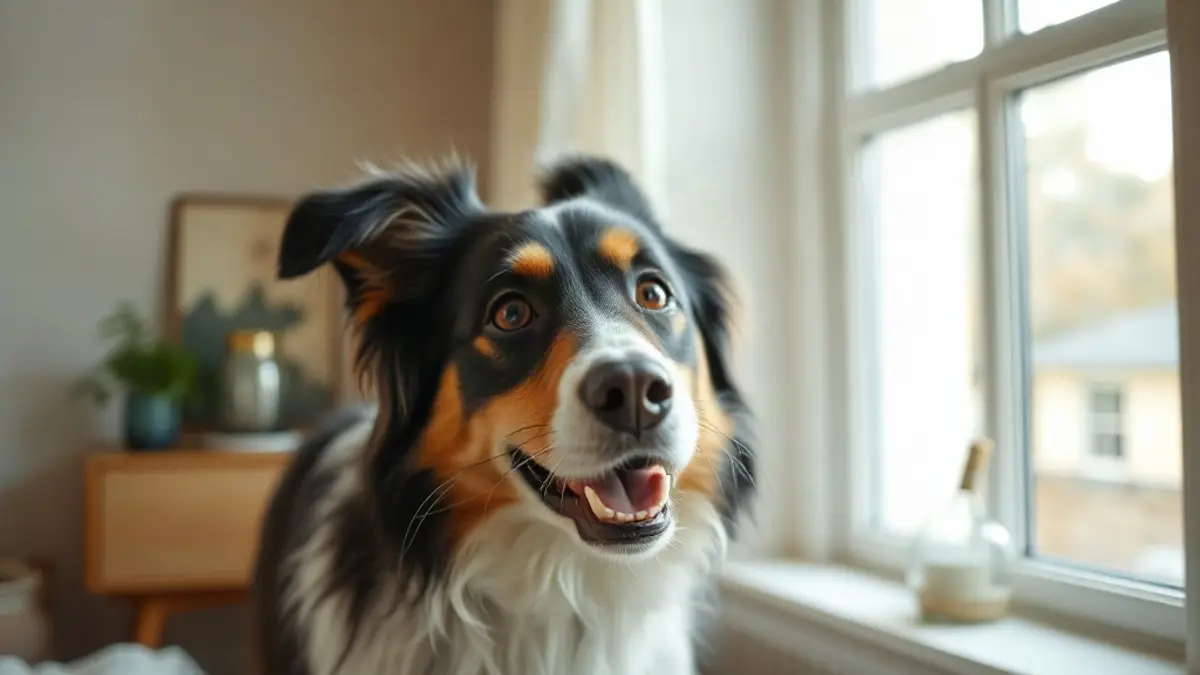
Reading the Daily Signals: What Would My Dog Say If He Could Talk?
Every dog owner has looked down at a quiet companion resting on the rug and wondered about the internal dialogue running behind those attentive eyes. If you ask yourself what would my dog say if he could talk, the answer rarely involves complex philosophical theories. Instead, it revolves around the micro-moments of your shared life. A dog’s world is built around scent, physical presence, predictable schedules, and the small rituals you have established together over months or years.
When we look closely at canine behavior, we see a complex system of vocalizations, ear positions, tail angles, and body weight shifts. Dog communication is rich and deliberate, even if it does not rely on spoken words. A head rested gently on your shoe while you sip morning coffee is not an accident; it is a clear expression of safety and connection. A sharp bark directed at the back fence might seem like simple noise, but to your dog, it is a vital status update regarding the neighbor’s cat.
To translate these actions, it helps to view your home from your dog’s perspective. Imagine a beagle named Pepper sitting near the kitchen counter. Pepper does not care about the mortgage payment or the morning news. Pepper cares that you just moved the ceramic peanut butter jar three inches to the left. If Pepper could talk, his narrative would be an ongoing commentary on human movements, kitchen sounds, and the profound mystery of why shoes are allowed outside but slippers stay inside.
The Language of Morning Routines
Morning routines provide some of the clearest behavioral signals of the day. The moment your eyes open, your dog reads your breathing patterns and slight shifts in posture. Before you even sit up, your dog has already calculated whether it is a weekday or a weekend based on your alarm tone or how quickly you move toward the closet.
During these initial moments of the morning, your dog’s actions serve as a daily greeting card. Soft tail wags, deep stretches that stretch into a lazy bow, and quiet nose nudges are intentional signals. They translate roughly to a warm welcome into the new day, accompanied by a polite reminder that breakfast serves as an excellent starting point for all human-canine interactions.
Decoding the Front-Door Reunion
Few events in a dog’s daily life carry as much emotional energy as your return home. Whether you were gone for eight hours at work or eight minutes to retrieve the mail, the reaction at the front door often feels disproportionately joyous. When considering why your dog gets excited when you come home, it helps to remember that your arrival marks the high point of their social day.
If you have ever caught yourself wondering what would my dog say if she could talk during that frantic, tail-wagging reunion, the translation is straightforward. It is a mix of relief, excitement, and a gentle demand for confirmation that the pack is whole again. The loose, wiggling body posture, the eager sniff of your hands, and the immediate search for a nearby shoe or toy to hold are all ways of processing high emotional arousal.
Door opens -> Body wiggle -> Toy grab -> Full-body lean
This sequence is standard across many breeds and personality types. The act of grabbing a nearby object—such as a slipper, a plush squeaker, or a stray couch cushion—is a displaced behavior. Your dog experiences so much joy upon your return that holding an object helps ground that energy. If translated into dialogue, your dog might say, “I am so happy you are back that I must hold this sock immediately so I do not explode with excitement.”
Why Your Dog Follows You From Room to Room
Shadowing behavior is one of the most common traits of companion animals. You walk to the kitchen to grab a glass of water, and your dog trots behind you. You move to the hallway closet to grab a sweater, and your dog sits near your ankles. You enter the bathroom, and a small snout immediately pushes against the door crack.
When exploring why your dog follows you from room to room, owners often wonder about the motivation behind this constant companionship. Is it anxiety, curiosity, or simple devotion? In most healthy scenarios, following a human around the house is a sign of social attachment and routine monitoring. Dogs are cooperative animals that naturally group together with their social partners.
If your dog could articulate this behavior, the explanation would likely sound like a friendly security briefing:
- “I am keeping an eye on kitchen operations in case a piece of cheese falls.”
- “You shifted your weight, which means an adventure might be starting soon.”
- “I prefer to rest on the floor where your feet are, regardless of which room that floor is in.”
- “Checking the hallway takes two seconds, and I am already standing.”
If my dog could talk to me while pacing behind my steps, he would explain that being in the same room is simply the default setting for a good partnership. It is not necessarily about needing constant attention; often, it is just about sharing the same physical space.
The Meaning Behind Long Stares and Silent Looks
Dog owners are intimately familiar with the direct, unblinking stare. You are sitting on the couch reading a book or watching television, and you look up to find your dog standing three feet away, staring directly into your eyes with absolute intensity. It can feel mysterious, funny, or slightly intimidating depending on the context.
To understand this gaze, researchers often look at how dogs communicate through visual cues and body language. Unlike wild canids, for whom direct eye contact can be interpreted as a challenge or threat, domestic dogs use soft, prolonged eye contact with trusted humans to reinforce social bonds and request information. Eye contact between a dog and an owner releases oxytocin in both species, creating a feedback loop of mutual calm.
When learning to read why your dog stares at you, context tells you everything. If the stare happens near five o’clock in the afternoon, your dog is serving as a living alarm clock, reminding you that dinner time approaches. If the stare happens right after you reach for your walking shoes, it is an inquiry about destination and intent. And if the stare happens while you are eating a sandwich, the translation requires no complex science at all: “That food smells incredible, and I believe in sharing.”
A Translation Guide to Everyday Dog Behaviors
To help visualize how daily actions translate into hypothetical dialogue, consider how common canine behaviors map to human language. While these interpretations are playful ways to read your pet’s mood rather than strict scientific facts, they capture the spirit of domestic life with a dog.
| Everyday Behavior | Likely Translation | Emotional Context |
|---|---|---|
| Pushing a cold nose against your calf while you cook | ”Just letting you know I am down here if anything hits the floor.” | Hopeful, alert, kitchen companion |
| Restricting your movement by sleeping across your feet | ”You are anchored to this spot now, which means we stay together.” | Content, secure, grounding |
| Presenting a dirty tennis ball without releasing it | ”Look at this treasure. You may view it, but do not take it away.” | Playful, provocative, interactive |
| Sighing deeply while settling into a dog bed | ”The household is quiet, my duties are complete, and I can rest.” | Relaxed, satisfied, peaceful |
| Tilting the head when you use a high-pitched tone | ”I recognize that voice pattern. Does it mean treat, walk, or car?” | Curious, focused, engaged |
| Rolling onto the back with paws curled in the air | ”I feel entirely safe in this house and prefer a belly scratch.” | Vulnerable, trusting, calm |
| Resting the chin heavily on your knee while you work | ”You have been looking at that glowing rectangle long enough.” | Affectionate, persistent, needy |
This translation guide shows how practical most canine signals are. Dogs rarely waste energy on indirect communication. Their physical signals match their immediate desires, security needs, and social drives.
What Would My Dog Say If He Could Talk About Your Daily Routines?
Every household develops its own unique rhythm. Your dog learns your specific habits with surprising accuracy. He knows the sound of your car turning into the driveway compared to the neighbor’s car. He knows the sound of the specific cabinet door where the dog treats are stored, distinguishing it instantly from the cabinet where the dinner plates live.
If you reconsider the question of what would my dog say if he could talk about your personal habits, the answers would likely highlight your small quirks. Your dog notices that you walk around the coffee table three times when looking for your keys. Your dog knows that when you put on heavy boots, it means a long walk in the park, but when you put on small slip-on shoes, it means a two-minute trip to grab the mail.
Taking time to reflect on these small details is a wonderful way to appreciate the dynamic you share. At Letter From My Dog, we created the free six-question experience to help dog owners capture these exact observations. In about one minute, without creating an account or paying a cent, you answer six simple questions about your dog—their name, how they greet you, their funniest habit, and what makes them wildly happy. The result gives you a personalized look at what your companion might say about your life together if he had the words.
Exploring what your dog thinks of you through these small everyday habits reinforces how closely our pets pay attention to us. They are constant, quiet observers of human behavior, finding comfort in our consistency and routine.
The Subtle Ways Dogs Show Trust and Affection
Affection in dogs does not always manifest as wild excitement or slobbery kisses. Often, the deepest signals of trust are quiet, subtle, and easily overlooked during a busy day. Understanding these signals helps answer the question of how dogs demonstrate bond and security within a human household.
When reflecting on the specific things your dog wants to tell you, pay close attention to physical contact and resting patterns. A dog that feels completely secure in his environment will exhibit relaxed body postures and choose locations that maintain proximity to his humans.
Here are several quiet ways dogs demonstrate deep trust and contentment:
- The Full-Body Lean: Standing against your legs while you converse with a neighbor or wait at a crosswalk, leaning their body weight gently against your shins.
- Exposing the Belly: Sleeping upside down with exposed paws, which indicates total comfort and a complete absence of perceived threat.
- Soft Eye Contact: Gazing at you with relaxed eyelids and a soft face, often accompanied by slow, lazy tail wags.
- Bringing Favorite Objects: Carrying a favourite plush toy or blanket over to your chair, not necessarily to play fetch, but simply to keep the object near you.
- Sighing in Proximity: Settling down next to your desk or chair and releasing a deep, audible exhalation as their body relaxes into the floor.
If what would my dog tell me could be condensed into these quiet moments, the message is simple: “I feel safe when you are nearby, and I trust that this environment is secure.” These subtle gestures often mean far more than high-energy greetings, as they represent sustained emotional comfort.
Understanding Toy Offerings and Shared Possessions
Why do dogs insist on bringing you things? You sit down after a long day, and within thirty seconds, your dog appears with a squeaky rubber hedgehog, dropping it precisely on your foot. If you pick it up and throw it, he brings it right back. If you try to take it, he holds on tight and lets out a low, playful grumble.
Toy offerings serve multiple social functions in canine communication:
- Social Initiation: Presenting an object is an easy, low-risk way to start an interaction with a human partner.
- Resource Sharing: Bringing a valued possession into your space demonstrates social comfort and a desire to share high-value items.
- Energy Management: Holding an object in the mouth helps regulate excitement, giving the dog a physical outlet for surplus energy.
- Play Invitation: Dropping an object near your hands tests your willingness to engage in a game of chase, tug, or fetch.
Imagine a golden retriever named Buster who retrieves a single dirty kitchen towel every time someone visits the house. Buster does not chew the towel or destroy it; he simply carries it in his mouth while marching proudly around the living room, wiggling his hips. If Buster could talk, he would explain: “I must hold something valuable to show my hospitality. This damp dish towel is my prized possession, and I am presenting it to you as a formal welcome.”
Understanding these object-oriented behaviors allows owners to engage more playfully with their dogs. Rather than viewing a stolen sock as bad behavior, viewing it through the lens of dog communication reveals it as a quirky, albeit slightly inconvenient, attempt to hold something that smells strongly of you.
When Behavior Changes Require Professional Insight
While interpreting dog behavior is a fun, warm exercise for owners, it is critical to remember that sudden shifts in behavior are not mere personality quirks. If a normally playful dog suddenly becomes distant, aggressive, lethargic, or starts vocalizing unexpectedly, these signals should never be ignored or treated as lighthearted commentary.
Changes in appetite, sudden onset of separation distress, unexpected defensive reactions, or unusual lethargy can indicate underlying medical issues, pain, or acute stress. In these situations, playful translation must step aside for real health evaluation. If you observe sudden behavioral changes or suspect your dog is experiencing pain, discomfort, or severe anxiety, consult a qualified veterinarian or a certified professional dog trainer promptly. A professional assessment ensures your dog receives appropriate care, proper diagnosis, and medical treatment when needed.
Turning Your Dog’s Daily Messages Into a Keepsake
Once you begin observing the tiny, specific habits that define your dog’s personality—the way he spins before sleeping, his obsession with tennis balls, or how he greets you at the door—you hold the ingredients for a wonderful story. Capturing those unique traits in writing allows you to preserve the everyday humor and heart of your relationship.
At Letter From My Dog, we specialize in turning those everyday details into beautiful, personalized keepsakes. Our core offering, Letter From My Dog™ ($7, one-time purchase), is a custom-written letter crafted from your perspective of your dog’s voice. Built directly from the details you share about your pet’s real habits, quirks, and routines, each order includes the main letter, Our Bond Story, 10 Little Things Your Dog Probably Loves About Life With You, The Tiny Things™, More Tail Wags bonding ideas, and A Memory Worth Keeping. You also receive a printable PDF formatted for easy framing at home, a custom phone wallpaper, and a digital Instagram story share card.
Everything is generated after purchase from your individual responses using generative AI to weave your exact memories into a cohesive narrative. If you want to expand your collection, we also offer a personalized digital dog storybook ($19) that turns your dog into the star of a full illustrated story, as well as a custom Dog Movie Poster Pack™ ($4) featuring your dog in fun movie genres. These digital keepsakes require no subscription and make meaningful mementos for any dog lover.
Frequently asked questions
Can dogs actually understand human language?
Dogs do not understand human language the way humans do, but they are exceptionally skilled at interpreting words, vocal tones, body language, and context. Research suggests that dogs can learn to recognize scores of specific command words and object names. More importantly, they respond strongly to emotional cadence and pitch, allowing them to gauge your mood accurately regardless of the exact words spoken.
Why does my dog make noise like grunting or sighing?
Dogs use vocalizations like grunts, sighs, and soft groans to signal shifts in physical comfort and emotional state. A deep sigh while settling into a bed usually signals relaxation and safety. A grunt when being petted often indicates physical satisfaction. However, if vocalizations sound pained or accompany difficulty moving, consult a veterinarian to rule out discomfort.
How can I tell if my dog is happy with me?
A happy dog displays loose, relaxed body posture, a soft facial expression, and regular engagement with family members. Look for gentle tail wags that involve the whole hindquarters, willingness to initiate play, healthy appetite, and a desire to rest near you. Trusting behaviors, like sleeping soundly in your presence or seeking soft physical contact, clear signs of content companionship.
Do dogs remember past events like humans do?
Dogs possess associative memory rather than the detailed episodic memory humans use to recall complex past events. They associate specific people, places, sounds, and scents with past feelings of safety, excitement, or fear. While your dog may not recall specific dates, he remembers how you make him feel, recognizing your voice, scent, and routines instantly even after long periods apart.
What does it mean when a dog leans against my legs?
When a dog leans his body weight against your legs, it is usually a physical sign of trust, closeness, and seeking connection. In canine body language, leaning against a social partner anchors the dog to you, offering physical reassurance and comfort. It is a quiet, low-energy gesture of affection that highlights your role as a safe, steady presence in his environment.
Keep reading
Things My Dog Wants to Tell Me (But Can't)
If your dog could leave a note on the kitchen counter, it would be full of tiny observations only you two share.
What Does My Dog Think of Me? A Playful, Honest Look
Science shows dogs view us as secure bases and daily partners. Here is a thoughtful, playful look at what goes on in your dog's head.

Dog Letter Generator: What Makes One Worth Using
An honest guide to dog letter generators, generic templates, privacy rules, and how custom details make digital keepsakes feel real.